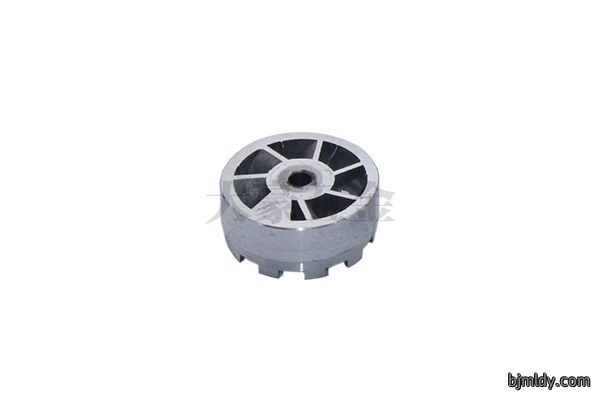
The end cover, commonly referred to as the back cover or rear housing component, represents a critical structural element positioned behind the motor assembly and its associated protective casing. Within the broader category of motor components, end covers exist in numerous configurations and variations, each tailored to specific motor types and applications. In the context of toy motors specifically, the end cover serves as an essential subassembly that comprises three primary structural elements: the cover body itself, which provides the main structural framework; the bearing system, which enables rotational movement and load distribution; and the brush blade assembly, which functions as the electrical and mechanical interface. The overall quality and structural integrity of an end cover directly influences the operational performance characteristics and longevity of the motor unit to which it is attached.
End cover, a critical component in motor assembly, generally refers to the structural element positioned at both extremities of a motor where the axial dimension exceeds the radial dimension, functioning primarily to establish and maintain the spatial positioning of the rotor shaft within the motor housing. This component must be engineered in coordination with various bearing configurations, as the bearing type directly influences how loads are distributed along the shaft axis and how rotational tolerance is managed.
Because as long as there exists any structural irregularity or dimensional deviation in the brush assembly configuration, it will precipitate a measurable degradation in the overall performance characteristics and operational reliability of the motor system. When the brush positioning exceeds the upper tolerance threshold, it will make direct contact with the varistor component, thereby creating unintended electrical pathways that compromise circuit integrity; conversely, when the brush sits below the lower tolerance boundary, the contact surface will strike the white washer assembly visible on the rotor structure, resulting in mechanical friction that generates heat and accelerates component wear.